Finance Bill 2026: The Practical Impact
Understanding Decriminalization through Real-World Scenarios
💡 Practical Example: Modern Retailers Pvt Ltd
Imagine a mid-sized company, Modern Retailers Pvt Ltd, facing an audit for FY 2025-26. During the assessment, three specific issues are identified. Let’s see how the Finance Bill 2026 changes their outcome compared to the old laws:
Scenario A: ₹8L Tax Under-reported
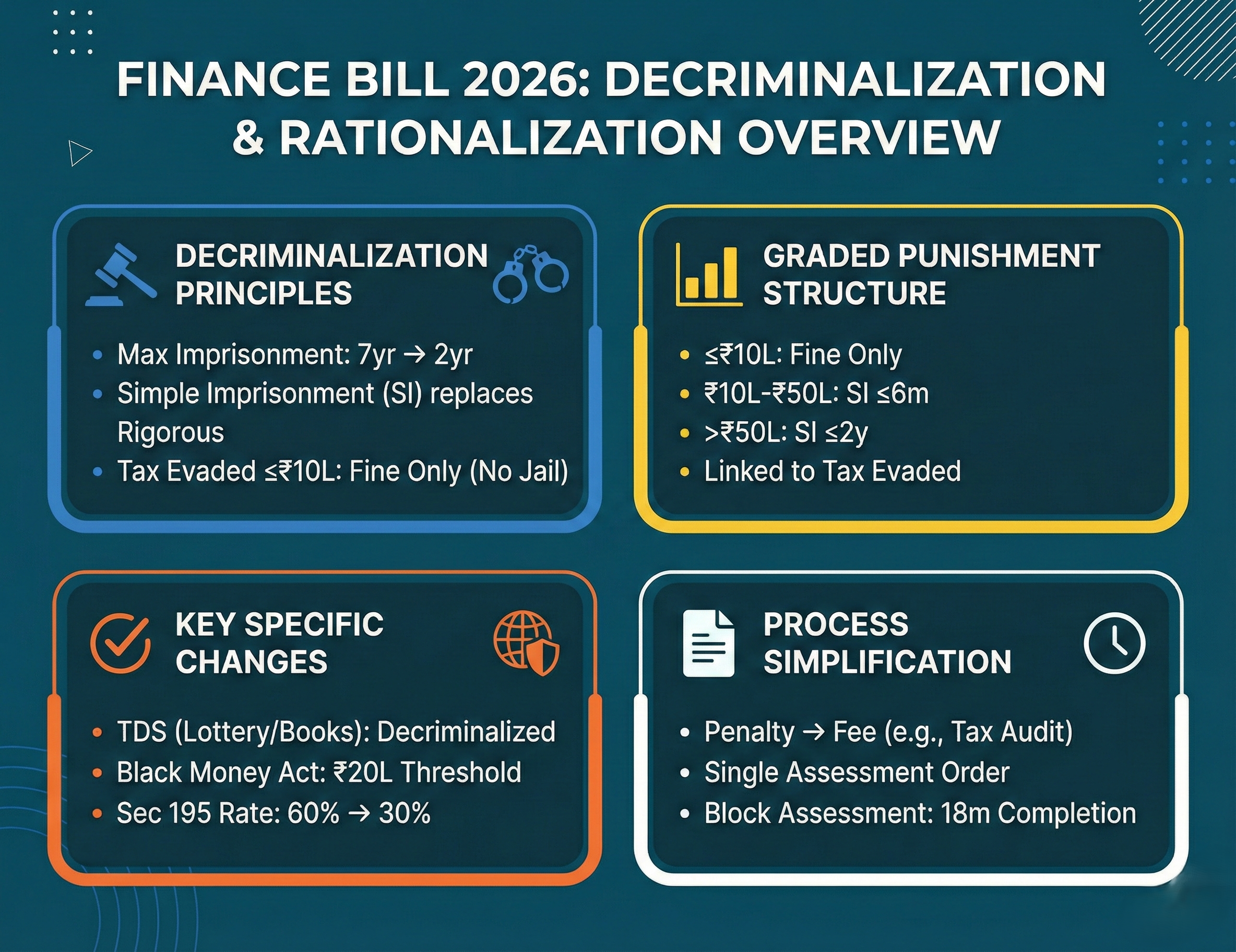
Under Old Law: Potential for Rigorous Imprisonment (3 months to 7 years) + Fine. High legal anxiety.
Prosecution Risk: HIGHScenario A: Under New Law
Outcome: Since the amount is ≤ ₹10L, there is NO imprisonment. The company only pays the tax and a fine.
RESULT: FINE ONLYScenario B: Failure to Produce Books
Under Old Law: Rigorous Imprisonment up to 1 year plus a daily fine. Criminal record potential.
CRIMINAL OFFENCEScenario B: Under New Law
Outcome: This section (Sec 481) is now fully decriminalized. It is treated as a civil non-compliance fee.
FULLY DECRIMINALIZEDThe “Civil” Shift: Penalty to Fee
The government is moving away from the “Criminal” label for procedural errors. Note the shift in terminology and cost:
| Nature of Default | Old Treatment (Penalty) | New Treatment (Fee) |
|---|---|---|
| Tax Audit Delay | 0.5% of turnover (Max ₹1.5L) | Graded Fee (Max ₹1.5L) |
| SFT Reporting Error | ₹500 – ₹1,000 / day (No Cap) | Capped at ₹1,00,000 Total |
| Foreign Asset < ₹20L | Prosecution under Black Money Act | Immunity from Prosecution |
The Micro Advisor Takeaway
This rationalization reduces the “Inspector Raj” fear for small and medium enterprises. By introducing clear financial thresholds (₹10L for jail and ₹20L for Black Money Act), the law now focuses on high-value tax evasion while allowing honest taxpayers to rectify errors through fees rather than court trials.