NPO Regulatory Updates 2025
Simplifying the Income Tax Act Amendments for Non-Profits
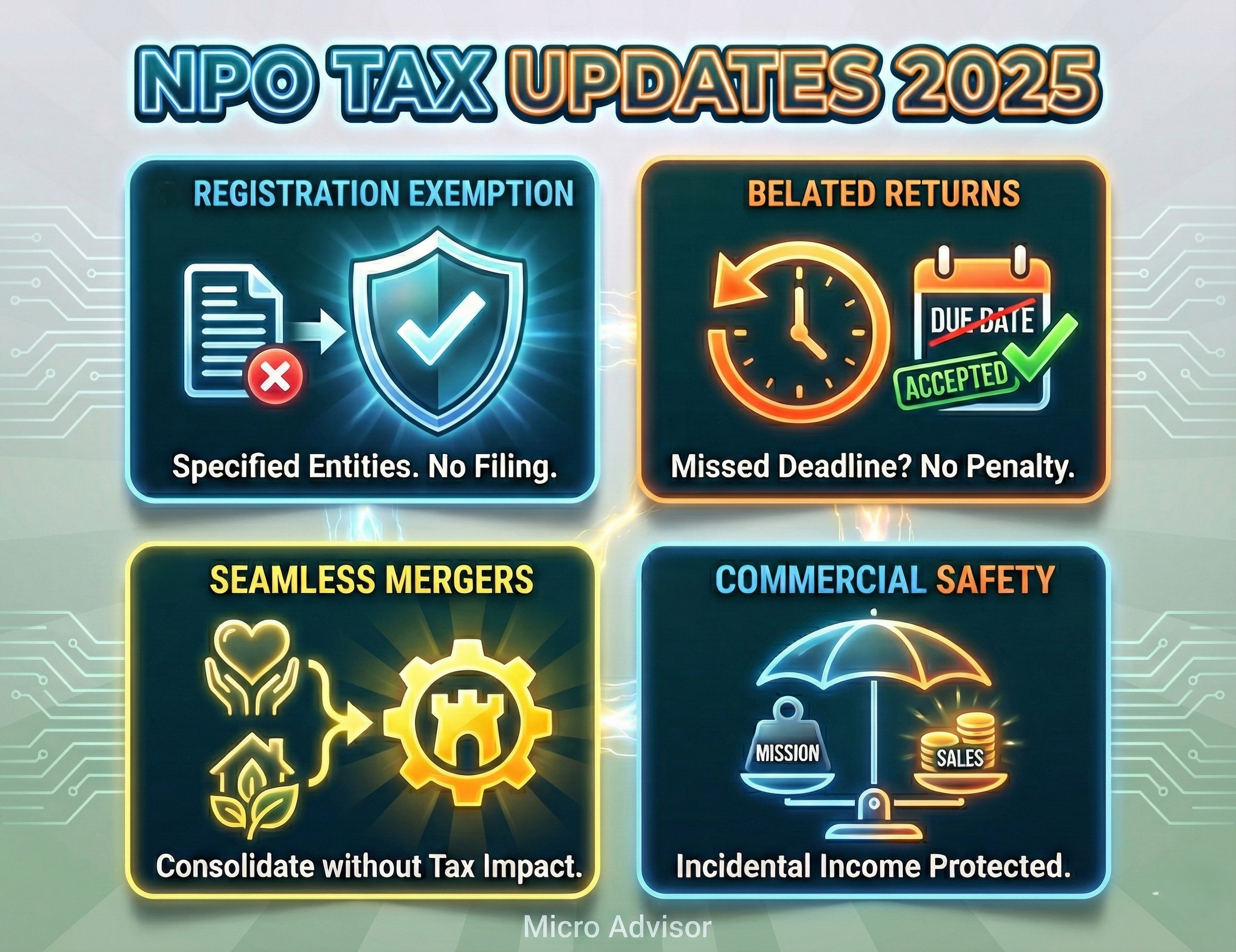
Navigating the legal landscape for Non-Profit Organizations (NPOs) has become streamlined under the Income Tax Act 2025. Below is a breakdown of the four critical changes and real-world examples of how they impact you.
Registration Exemptions
Certain entities listed in Schedule VII (Sl. 10 to 16) are no longer required to go through the rigorous NPO registration process. This reduces the compliance burden significantly for specific government-linked or statutory bodies.
“City Green Initiative,” a statutory body formed under a State Act for environmental protection (listed in Schedule VII Sl. 12), was previously preparing a 50-page registration dossier. Under the new K.1 provision, they can stop the paperwork immediately; they are now automatically exempt without filing for registration.
Belated Returns Allowed
Historically, missing a filing deadline meant losing tax exemption. The amendment to Section 349 now allows NPOs to file Belated Returns without stripping them of their exempt status.
| Old Rule | New Rule (2025) |
|---|---|
| Must file by due date strictly. | Can file after due date (Belated). |
| Consequence: Loss of Exemption. | Consequence: Exemption Retained. |
The “Bright Future Orphanage” suffered a server crash on the tax filing deadline of October 31st. In previous years, filing on November 2nd would have cost them their tax-free status for the whole year. Under the new rule, they file on November 2nd as a “Belated Return” and retain 100% of their tax benefits.
Seamless NPO Mergers
Section 354A introduces a dedicated framework for merging two NPOs. Previously, this was a grey area that often triggered tax liabilities on the assets being transferred.
Two small charities, “Feed the Hungry” and “Food for All,” decide to merge to save on administrative costs (office rent, software). Using Sec 354A, they consolidate their assets into one entity. The transfer of their delivery vans and kitchen equipment is not treated as a taxable sale, allowing the full value to remain within the charity.
Commercial Activity Safety
Section 351 has removed “commercial activity” from the list of violations. NPOs can now undertake incidental commercial activities to support their main cause without fear of deregistration.
A Non-Profit Art Museum opens a small gift shop selling prints and coffee to visitors. Previously, this “commercial activity” might have been flagged as a violation, risking their status. Now, the museum can freely use the profits from the gift shop to fund their art restoration projects without penalty.