Key Changes in TCS & STT Rates: What Investors and Businesses Must Know
By Micro Advisor | Your Trusted Guide to Financial Clarity
Navigating the ever-evolving landscape of Indian taxation can be a challenge. In recent policy updates, the financial framework has undergone significant restructuring, particularly concerning Tax Collected at Source (TCS) and the Securities Transaction Tax (STT).
Whether you are planning a vacation abroad, trading in the futures and options (F&O) market, or managing business commodities, these regulatory shifts will impact your cash flow. Let the experts at Micro Advisor break down these complex changes into simple, actionable insights.
1. The Standardization of TCS Rates
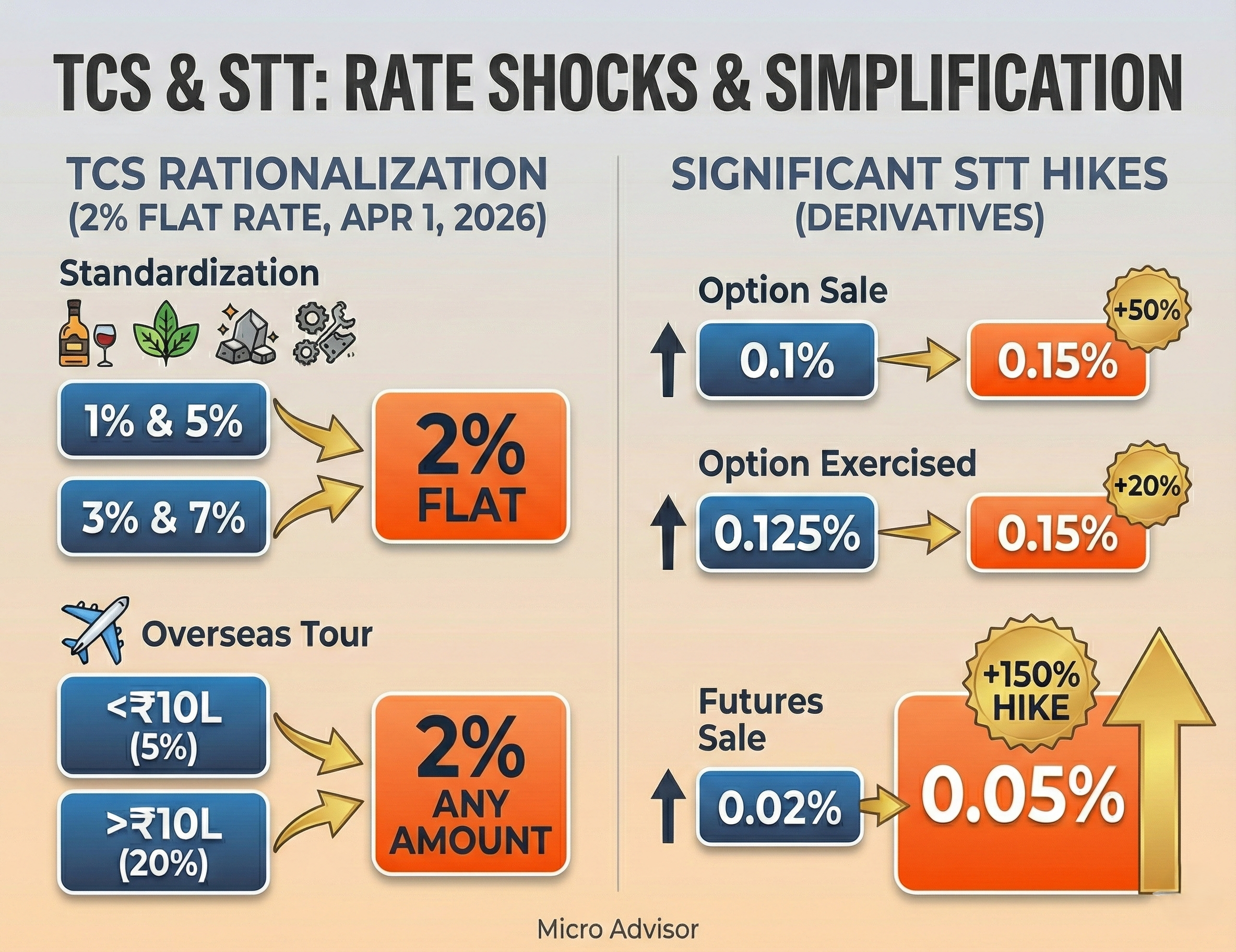
Beginning April 1, 2026, the government is introducing a major rationalization of the TCS framework. The primary goal is to simplify the tax structure by moving several distinct categories toward a unified flat rate.
| Category / Transaction | Previous Rate | New Rate (Effective Apr 1, 2026) |
|---|---|---|
| Sale of Alcoholic Liquor | 1% | 2% |
| Sale of Tendu Leaves | 5% | 2% |
| Sale of Scrap | 1% | 2% |
| Sale of Coal, Lignite & Iron Ore | 1% | 2% |
| LRS – Education & Medical (> ₹10 Lakhs) | 5% | 2% |
| LRS – Other Purposes (> ₹10 Lakhs) | 20% | 20% (Unchanged) |
✈️ Massive Relief for Overseas Travelers
Previously, international travelers had to navigate a tiered system for overseas tour packages (5% for packages under ₹10 Lakhs and a steep 20% for anything above). The government has now completely removed the financial threshold. Moving forward, all overseas tour packages will attract a flat 2% TCS.
💡 Practical Example: Booking a Europe Vacation
Imagine you are booking a luxury Europe family vacation worth ₹15,00,000 through a tour operator.
Under the NEW Rule (2% TCS): TCS Amount = ₹15,00,000 × 2% = ₹30,000 Total Upfront Cash Required = ₹15,30,000
The Impact: While TCS is adjustable against your final tax liability, the new rule saves you from blocking ₹2,70,000 in upfront cash, giving you more liquidity for your trip!
2. Sharp Hikes in Securities Transaction Tax (STT)
While the TCS updates brought relief, active stock market participants—specifically those trading in the derivatives segment—are facing increased operational costs. To curb excessive retail speculation, the government has drastically increased the STT on Futures and Options (F&O).
| Derivatives Transaction | Previous STT | New STT | Percentage Hike |
|---|---|---|---|
| Sale of Options in Securities | 0.1% | 0.15% | +50% |
| Sale of Options (Exercised) | 0.125% | 0.15% | +20% |
| Sale of Futures in Securities | 0.02% | 0.05% | +150% |
💡 Practical Example: The Intraday Futures Trader
Let’s say you are an active trader who sells Futures contracts worth ₹10,00,000 in a single transaction.
Under the NEW STT Rate (0.05%): Tax paid on sale = ₹500
The Impact: You are paying ₹300 more per trade. If you execute 100 similar trades a month, your monthly tax burden increases by ₹30,000. High-frequency traders and scalpers will need to recalculate their breakeven points immediately.
The Bottom Line
These dual financial updates represent a balancing act by regulatory bodies. On one hand, consumer-friendly policies like the flat 2% TCS on foreign tours are encouraging global travel. On the other hand, the aggressive STT hike is a clear signal to temper retail speculation in the highly volatile derivatives market.
At Micro Advisor, we recommend reviewing your trading strategies and upcoming financial expenditures with your tax consultant to adapt to these new norms seamlessly.
Disclaimer: This article is for informational purposes only and does not constitute formal financial or tax advice. Always consult with a certified financial planner or chartered accountant before making significant financial decisions.
Contact the experts at Micro Advisor.
Contact Us